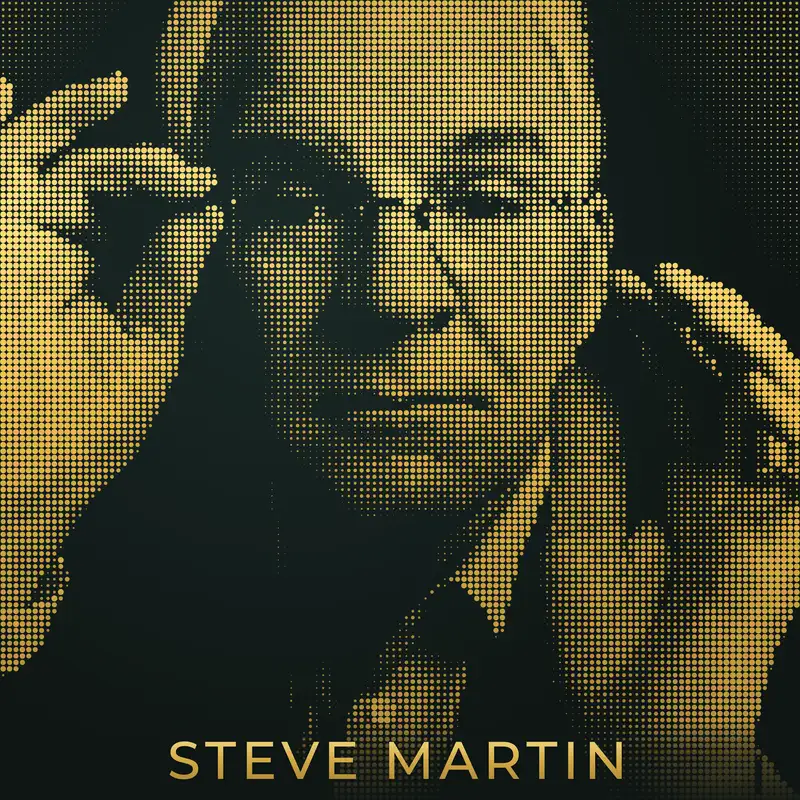
Letter to Steve Martin: Obsessed by Making
Download MP3I'm Bill Allred, and this is Craftsmith, a podcast about people who discover and develop work they love so you can too. This episode is a Craftsmith letter to Steve Martin. It's a gift; a thank you for how his work has shaped how I think about mastery and also an invitation. Steve, if this letter reaches you, I'd love to record an episode together.
Bill Allred:In 1977, Steve Martin played Nassau Coliseum in New York. 45,000 people attended a comedy show, the biggest concert comedy event in the history of show business. He reached this peak despite having, in his own words, no natural talent. After eighteen years of striving, he finally stood at the pinnacle of his craft as a comedian. And then, he just moved on.
Bill Allred:He didn't perform stand up again for decades. During that time, he became an actor, a screenwriter, novelist, playwright, essayist, composer, and a touring musician. Most people struggle to find a single craft to master. And those who finally do tend to cling to their success. So why would Steve reach the pinnacle and walk away? And then start over again in a new discipline and do it again and again?
Bill Allred:I think Steve discovered something most people get backwards. Mastery isn't the destination. It's just a vantage point, and each new peak reveals the next one. And that secret was hiding in plain sight in the very next line of a poem Steve spent a decade trying to understand.
Bill Allred:Here is my letter to Steve Martin.
Bill Allred:Steve, you once said you wished you'd done one thing and created a masterpiece. But your life tells a different story. Every time you reached the peak of comedy, of film, of writing, you evolved. I think the answer is in something you puzzled over for a decade.
Bill Allred:You spent ten years trying to understand a single line of poetry: "Like the burlesque comedian, I am abnormally fond of that precision which creates movement." Years later, after thousands of performances, you finally worked out its meaning. It meant moving the plot forward, filling every moment with content, mastering comedy until every word, every gesture propelled the act's momentum.
Bill Allred:But here's what took me by surprise. I found the book where that quote came from, six non lectures by EE Cummings. And the very next line, the line you never mention reads, "If a poet is anybody, he is somebody to whom things made matter very little. Somebody who is obsessed by making."
Bill Allred:Let me say that again.
Bill Allred:"Somebody to whom things made matter very little. Somebody who is obsessed by making." You've expressed regret over not creating something you consider a masterpiece. But, your life shows an obsession with making. And that obsession made you who you are.
Bill Allred:It seems to me that you spent a decade puzzling over the first half of an idea, while unconsciously living out its second half. Let me show you what I mean.
Bill Allred:It started with watching. You trained yourself to perceive what others missed. At Disneyland, in the Golden Horseshoe Review, you found your first teacher in Wally Boag. By your own estimate, you watched Wally's show hundreds of times. "I absorbed Wally Boag's timing", you wrote, "saying his next line in my head, and took the audience's response as though it were mine. I studied where the big laughs were, learned how Wally got the small ones, and saw tiny nuances that kept the thing alive between lines."
Bill Allred:At Merlin's Magic Shop, you found another teacher in Leo Benke, who performed tricks with a deck of cards and coins. But you were transfixed by his hands. "He handled cards with delicacy", you wrote. "There was a rhythm to his movements that was mildly hypnotic. It was my first experience with the pleasure and subtlety of physical expression, and I became aware of the potency of movement."
Bill Allred:Then a magician named Dave Stewart introduced what he called the glove into dove trick. He announced it, threw a white glove into the air, and let it simply fall to the floor.
Bill Allred:Silence followed, and then laughter. "It was the first time I had ever seen laughter created out of absence." You were just a teenager, still in high school, with the run of Southern California available to you in the nineteen fifties. But that's not all that was happening.
Bill Allred:Your father, Glenn, and he was always called Glenn in your home, had abandoned his own dream of being an actor. The relationship was strained and distant. Years later, on his deathbed, he finally said, "You did everything I wanted to do." "I did it for you", you replied. But you've written the more complicated truth that you kept to yourself at the time. "I did it because of you."
Bill Allred:You wrote, "I tell you this story of my father and me to let you know I am qualified to be a comedian."
Bill Allred:Following Disneyland, the Bird Cage Theater at Knott's Berry Farm became your laboratory. Six minutes at a time, four times a day, five on Sunday for three years. That's over 4,000 performances, 4,000 reps to master conventional comedy. You knew where every laugh was supposed to land.
Bill Allred:And that was exactly when you could see what others couldn't. You had reached your first peak. "I looked around the Bird Cage", you wrote, "and saw actors who had worked there fifteen years and counting. And I knew it could be a trap for me." So you walked away.
Bill Allred:And because you'd mastered the rules, you could finally ask, what if I broke them? "What if there were no punch lines?" you said. "What if there were no indicators? What if I created tension and never released it? What would the audience do with all that tension?"
Bill Allred:Your theory was if you kept denying them the ritual of a punch line, the audience would eventually pick their own place to laugh out of desperation. "This type of laugh seemed stronger to me, as they would be laughing at something they chose, rather than being told exactly when to laugh." Your goal, as you put it, was to make the audience laugh, but leave them unable to describe what it was that had made them laugh. "In other words, like the helpless state of giddiness experienced by close friends tuned into each other's sense of humor, you had to be there."
Bill Allred:"You had to be there" is normally an apology. It usually means the joke didn't travel. But you made it the goal. You'd learned the rules so well, you could see that the next step was to turn them inside out.
Bill Allred:"I went on stage and began, I'd like to open up with sort of a funny comedy bit. It's the nose on microphone routine. I leaned in and placed my nose on the mic for a few long seconds. Then I stopped and took several bows, saying, thank you very much." The laugh didn't come right away, but only after the audience realized you had already moved on.
Bill Allred:And the critics didn't hold back. "One said, this so called comedian should be told that jokes are supposed to have punch lines." Another said, you "represented the most serious booking air in the history of Los Angeles music." They couldn't categorize what you were doing. They're very critique proved that it was original.
Bill Allred:And your response was perfect. "I liked it. I just wanted it to work."
Bill Allred:Years later, you said something I love. "Through the years, I have learned there is no harm in charging oneself up with delusions between moments of valid inspiration."
Bill Allred:When you left Hollywood to go on the road, your agent told you plainly, "stick to writing". You took the warning with, your words, "strange delight."
Bill Allred:"In this netherworld, I was free to experiment," you wrote. "There were no mentors to tell me what to do. There were no guidebooks for doing stand up. Everything was learned in practice, and the lonely road with no critical eyes watching was the place to dig up my boldest or dumbest ideas and put them on stage."
Bill Allred:At the Abbey Cellar in Aspen, a basement club hard to find even for the performers, you got your first serious heckler. "Sitting at the front table with his wife and another straight looking couple, he stood up and said, see if you think this is funny, and threw a glass of red wine on me."
Bill Allred:One night at the ice house, you realized you'd been on for twenty minutes without a single laugh from a dead Tuesday night crowd. "I thought, why not go for the record? I set my mind to it and finished the show without having roused one snicker."
Bill Allred:"On the road," you wrote, "the daylight hours moved slowly, filled with aimless wandering through malls and museums. But at night, on stage, every second mattered. Every gesture mattered."
Bill Allred:Something you haven't talked about as much though was the anxiety attacks that started during those years. You had panic about dying. You couldn't walk into a movie theater for a decade. The dark felt like a trap. And yet, every night, you walk onto a stage alone under the lights and tried to make strangers laugh. Think about that. You were perfecting the art of comedy while privately convinced you were about to die. These daylight hours are slow and aimless, but those nights were electric, precise, where every gesture was calibrated.
Bill Allred:And yet underneath it all, you're feeling mortal terror. "I learned over the next months that I could do several things at once," you wrote. "Be a comedy writer, be a stand up comedian, and endure private mortal fear."
Bill Allred:You were 28 years old when a bleak thought cut through. "What if nothing happens? I had never really imagined success. I was just trying to be a performer, but I could not see myself playing dreary nightclubs into my thirties, forties, and fifties." You gave yourself until 30. Two years to make something happen or find something else to do.
Bill Allred:"It was easy to be great," you wrote. "Every entertainer has a night when everything is clicking. These nights are accidental and statistical, like lucky cards in poker. What was hard was to be good, consistently good, night after night, no matter what the abominable circumstances."
Bill Allred:You landed on a clever method. "When I had new material to try, I would break it down into its smallest elements, literally a gesture or a few words, then sneak it into the act in its shortest form, careful not to disrupt the flow. If it worked, the next night I would add the next discrete packet, until the bit either filled out or died."
Bill Allred:Years later, you'd write, "I view this time with surprising warmth. One can have, it turns out, an affection for the war years."
Bill Allred:I think I know why. You didn't need to see where it was leading. The pursuit itself was giving you direction.
Bill Allred:At Vanderbilt University in Nashville, you performed for about a 100 students in a classroom. The show went fine. But when it was over, something odd happened. The audience didn't leave. "I indicated that the show had ended, but they just sat there even after I said flatly, it's over. They thought this was all part of the act." There was no exit from the stage except through the audience, so you kept talking. You walked among them ad libbing. As you walked into the hallway, they followed.
Bill Allred:Then you came across a drained swimming pool. "I asked the audience to get in. Everybody into the pool, and they did. Then I said I was going to swim across the top of them, and the crowd knew exactly what to do. I was passed hand over hand as I did the crawl."
Bill Allred:"That night, I went to bed feeling I had entered new comic territory. My show was becoming something else, something free and unpredictable. And the doing of it thrilled me, because each new performance brought my view of comedy into sharper focus."
Bill Allred:"Some nights," you wrote, "it seemed that it wasn't the line that got the laugh, but the tip of my finger." You had become the act.
Bill Allred:That question from years ago, "what if there were no punch lines"? You'd become the answer. And that's when you finally understood the Cummings line you had been puzzling over. The precision that creates movement.
Bill Allred:And so, having understood that, you started climbing towards the next peak.
Bill Allred:60 cities in sixty three days. 72 cities in eighty days. 85 cities in ninety days. "I played Nassau Coliseum in New York. How many tickets sold? 45,000."
Bill Allred:"This lightning strike was happening to me. Stephen Glenn Martin, who had started from zero, from a magic act, from juggling in my backyard, from Disneyland, from the Bird Cage. And I was now the biggest concert comedian in show business ever."
Bill Allred:And then, Steve, you just stopped.
Bill Allred:When you moved to film, you brought your methodology with you. "When I started making movies, I thought, okay, I have to make 40 movies to get five good ones." When you started writing, you said, "I started thinking, well, you can't just write one because that'd be a fluke. Two still sounds like a fluke. I have to write 10.
Bill Allred:So you write 10. And then I started getting into prose, and then you start thinking, hey, what about a longer thing? Do I have anything to say?"
Bill Allred:Steve, I don't think you've had five careers. I think you've had one lifelong practice in five costumes. You never stopped making. That's the obsession Cummings was talking about. You just kept finding new things to make.
Bill Allred:And I think there's one exception in your life that actually proves the point.
Bill Allred:"Banjo is completely divorced from anything else I was doing," you said. "It didn't have anything to do with the arts or anything. I just love the banjo." There's no strategy, no question to answer, there's no career move, just love for the banjo. And yet, "I had taught myself by slowing down banjo records on my turntable and picking out the songs note by note."
Bill Allred:I see that same patient attention, The same willingness to start again from zero. The same methodology that ends up in Grammy winning mastery.
Bill Allred:The banjo is kinda like the control group of this experiment of your life. When there's no theory to prove, no career at stake, no question driving you forward, you still create. You can't help it. The Cummings line isn't just a metaphor. You are literally obsessed by making.
Bill Allred:"In art, once the thing is made, you let it go," you wrote. "Moving on and not looking back, not living in the past was a way to trick myself into further creativity." You called it a trick. But Steve, you also said, "I would prefer to have done one thing and created a masterpiece."
Bill Allred:You're judging yourself by the things you've made. The masterpiece you say you didn't create. But your life proves something else. It proves an obsession with making. That Cummings line you never mentioned says that things made matter very little.
Bill Allred:So walking away isn't just a trick. It's what happens when you reach the peak and can finally see the next one. Each peak taught you something and once you learned it, the next peak was already calling. I don't think that's a flaw. I think that's wisdom.
Bill Allred:That's what I see, Steve. Beyond the stadiums, the movies, or awards, I see a kid watching Wally Boag hundreds of times, absorbing precision from the silence between laughs. A 28 year old giving himself until 30, breaking material into its smallest elements night after night. And I see an artist who couldn't stop making, even after 45,000 screaming people had proven he'd made it. Each time you mastered something, you became someone who could see the next peak.
Bill Allred:If you'd stopped at magic, you never would have found comedy. If you stopped at comedy, you never would have discovered what was waiting in film, writing, or music. Each peak revealed the next one. And I think that's what the second Cummings line is really about. What matters is the making and what it shows you next.
Bill Allred:If this letter finds you, Steve, the invitation stands. I'd love to hear how that second Cummings line lands with you now.
Bill Allred:This has been a Craftsmith Letter to Steve Martin. If you saw yourself in that story, here's something you can do this week. What's the thing you've been curious about, but keep dismissing as trivial? Give it an hour. Not as a career move, just as curiosity.
Bill Allred:If you think Steve should hear this letter, you can help me deliver it. Send him this episode. I'll put links to his site and socials in the show notes.
Bill Allred:If you want to know whether it reaches him and what happens if it does, follow Craftsmith wherever you get your podcasts.
Bill Allred:I'm Bill Allred. Thank you for listening to Craftsmith.