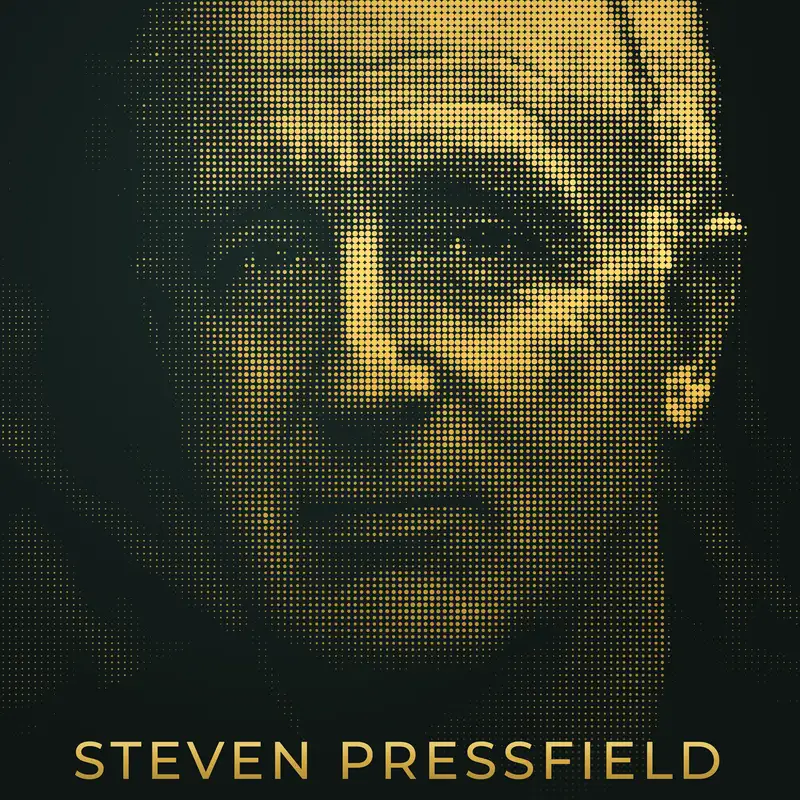
Letter to Steven Pressfield: Naming the Creative Enemy
Download MP3Welcome to Craftsmith, a podcast about people who discover and develop work they love so you can too. This episode is a Craftsmith letter to Steven Pressfield. It is a gift. A thank you for how his work has impacted me and also an invitation. Steven, if anything here rings true, I'd love to record an episode together.
Bill Allred:Most people know Steven as the author of The War of Art, a book about the invisible force that stops you from doing the work you care most about, which he called Resistance. He mapped its patterns, exposed its tricks, and told us how to fight it. Millions of us carry that book into creative battle every day. But here's what I've never heard anyone ask. Why Steven?
Bill Allred:Why did a late bloomer who didn't publish his first novel until 52, an author who was never adored by critics, why did he become the biographer of Resistance? How did this guy become the definitive voice for something experienced by every person doing work they care about? Here is my letter to Steven Pressfield.
Bill Allred:Steven, for years, I've read The War of Art and its siblings, and like millions of others, I hear the authority in your voice when you write about Resistance. The way you describe its tactics, how it attacks hardest when we're closest to the work our soul needs most, how it disguises itself as rational objection, how it never rests.
Bill Allred:Your writing makes me feel normal, like few others who write about doing creative work can. In fact, your writing feels more like reconnaissance, the kind that only comes from someone who has fought the war firsthand. I think it's because you didn't just make up Resistance. You gave a name to a real phenomenon you'd been fighting hand to hand for twenty seven years. Every chapter of The War of Art traces back to a specific loss you suffered or a desperate battle you fought that somehow succeeded against all odds.
Bill Allred:There's something in your memoir, Govt Cheese, that changed how I understand The War of Art. You said, "People who have read my books, particularly The War of Art and its cousins, have a vague idea of the odyssey of a particular solitary guy, wracked by guilt and riven by self doubt, as he struggles towards his destiny as a writer. But they have only the scantiest conception of the particulars of that journey. These particulars, I'm hoping, may be of use to others as they wrestle with their own version of that same odyssey."
Bill Allred:Most people assume that writers always knew they were a writer, but you didn't. You were working as a junior copywriter at Benton and Bowles in New York City when your boss, Ed Hannibal, published a novel called Chocolate Days Popsicle Weeks. It was a hit. Ed quit the agency, and you thought, "Shit, I'll do that too. How hard can it be? That's when the idea of being a writer entered your life.
Bill Allred:You didn't have a calling the way that it's so often imagined. You had something more like an impulse, and that's when Resistance found you. Years passed. Your first novel failed. In that time, your marriage also failed, and you drifted.
Bill Allred:Oil rigs, odd jobs, cross country drives, and through all of those years, you carried a typewriter, your Smith Corona, in the back of your van wrapped in an army blanket without taking it out once. You wrote that you hated that typewriter. A constant reminder of your failure as a husband, as a writer, as a man. And somewhere in there, you wrote, "How did I get to be this person I am who can't do anything, who lives in fear twenty four hours a day, possesses no skills and no sense of what he wants or how, even if he did know, he could get there." That was the voice of Resistance, and it was just getting started with you.
Bill Allred:It was 1971, you're 28 years old, and you walk into Burton Lines Trucking in Durham, North Carolina, having just been fired from a delivery job for stealing a can of grapefruit juice. There you met Hugh Reeves, also a former Marine like yourself, and he took a chance on you. Here's what was happening inside you at the time. "Of every action I have taken from minute one at Burton Lines, the primary terror in my mind, which has never left my thoughts for an instant, is am I going to fuck this up?" Every single day, you're walking on a wire just waiting to fall.
Bill Allred:While working at Burton Lines, you were staying in a basement room for $25 a month. You'd later realize this was a halfway house for people released from state mental institutions. And in this constant state of fear, one night, you have a dream. "I came into my basement room and found that my shirts had all folded themselves in the drawer instead of being mashed together in their usual jumbled mess. My boots had crawled out from under the bed where I normally kicked them. They had set themselves upright. They had shined themselves. When I woke up, I thought, I'm ambitious. I have ambition." That was the first turning point.
Bill Allred:I don't think it was a turning away from fear necessarily. The fear never left you, But a decision to move through it anyway was made in that moment. You wrote, "I'm going to make it here. I will learn what I have to learn. I will overcome whatever I have to overcome."
Bill Allred:So your mind was made up, but you weren't through the hard part yet. Months later, you drop a trailer load of expensive machinery on its nose in a parking lot. Hundreds of thousands of dollars in freight was damaged. After you'd nearly proven to yourself and everyone else at Burton Lines that you were exactly the failure you feared, Hugh Reeves took you to a diner and delivered what you would later call the lecture. He told you that Burton Lines was a commercial enterprise designed to make money, and that when he gave you a load, he expected you to deliver it on time and intact.
Bill Allred:"You're a professional", he said. "Your job is to deliver loads." That phrase, you're a professional, entered your vocabulary there in that diner booth. Your mind heard it clearly. Show up, do the work, deliver the load.
Bill Allred:You immortalized this concept in The War of Art, and even wrote an entire book on the subject called Turning Pro. But there was a bumper sticker on a pickup truck that day as well. "If your heart is not in Dixie, get your ass out." You didn't know it yet, but that bumper sticker was talking to you too. Your mind was learning to turn pro, but your heart was still searching for who you really were.
Bill Allred:Decades later, you'd write a book called Put Your Ass Where Your Heart Wants To Be. Both lessons were planted in that diner. So when you wrote about what it means to turn pro, when you described the shift from amateur to professional as the decisive break with Resistance, I think you were calling back to what Hugh Reeves told you in that diner. A fellow Marine who looked at your wreckage and told you that none of your drama mattered, only the work. But that bumper sticker was waiting for you too. Your heart had somewhere else it wanted to be.
Bill Allred:Your favorite deliveries at Burton Lines were the deliveries nobody wanted. The low paying surplus food runs to churches in small Coastal Carolina towns. You wrote, "If you are a writer, sometimes you feel like a ghost. It's not you who's really producing the work.
Bill Allred:You understand that you're a vehicle, like a truck is a vehicle. You, the driver, are just the medium. No one knows your name, and you don't know theirs. That's writing. That's any form of art. You feel in service to something, but you're not sure what." I think that's why you called your memoir Govt Cheese. Because those runs, delivering surplus food to people who needed it, were the first time you felt like a vehicle for something larger than yourself. The first glimpse of what writing would eventually become for you.
Bill Allred:You were 12 years old when you handed Frank the caddy master a handwritten list on the back of a scorecard. The list contained the names of golfers you were willing to caddy for. Not the ones who tipped well, but the ones with the most technically perfect swings. You said, "For us caddies, the learning track was old school. Find somebody great and study the hell out of them. On a typical round, I would deliberately station myself so I could watch and imbibe certain specifics of their technique. I studied their grips. I inhaled their attitudes. I missed nothing." That was you at 12, learning by immersion, by proximity, finding pros, and absorbing everything they did until it was in your bones.
Bill Allred:Twenty years later, you were in California in a little house in Carmel Valley, and you were doing the exact same thing. Only now your approved players were Dostoyevsky, Tolstoy, Hemingway, Mark Twain, Virginia Woolf, Homer, Plato, and Shakespeare. You were writing all day and reading all night, positioning yourself in relation to the masters the same way you once positioned yourself on the golf course, studying the swing, inhaling the attitude. I love that you called it imbibing.
Bill Allred:You went on, "I read everything you're supposed to read in high school and college, but never do. Or if you do, you're so psyched to read to the test that you don't learn a damn thing. Am I learning anything now? Fuck no. The books pass through my consciousness like sunlight through glass. I don't care. They're in my cells now. I love them. Their impress has etched itself in some occult recess of my heart." Man, what a line.
Bill Allred:I wanna talk about those twenty two months in California because I think most people who discover and develop a craft pass through a phase like this. A phase you described as "A season when you have no responsibility except to your own muse and your own demons. A run of months when you're invisible to everybody but yourself. When you don't give a shit about anything except the challenge before you." During that time, you were living on $2,700 you'd saved from an ad job. Each Monday, you walked into the bank and cashed a check for $25. That had to last you the week.
Bill Allred:You got up at five, made yourself what you called a power breakfast. Not sausage or bacon, but liver, because you wanted the fuel. "I'm not here to fuck around, you wrote. I will finish this book or kill myself trying." You had no friends, no girlfriend.
Bill Allred:You were working on a novel about Burton Lines and Hugh Reeves even though you had no idea how to write a novel. All you knew how to do was work. And something happened during those months that you described in language that sounds almost mystical. You wrote, "The inner journey and internal transformation ran far deeper, even though I didn't know it then and couldn't have articulated it if my life depended on it. There are gods who watch over lost souls, particularly those who dream. And when these divinities unknowable purposes align with the enterprise of these exiled souls, a force begins to flow that is as unquenchable as it is pure and as knowing as it is indefatigable. When you are alone with your solitary obsession, each day builds upon the one before. Energy concentrates. Your passion and intensity create a planet all your own."
Bill Allred:You talk about how this planet has its own gravitational field in a sense and how that field attracts ideas. Ideas for dialogue, for characters, for words you didn't know you knew.
Bill Allred:You concluded, "As I write this now, almost two generations have passed, yet the weeks and months of that time remain vivid to me. Nothing in my life before or since has penetrated me like those two years." These are the words of someone who has gained the upper hand against Resistance. It is what you would later call approaching the mystery. But when you lived it, you had no framework for what was happening. You were just alone, trying to finish something you'd never finished before, trying to beat Resistance.
Bill Allred:You were alone with the exception of Paul Rink. Paul had known John Steinbeck from Salinas. He lived two doors down from Henry Miller in Big Sur.
Bill Allred:He was the one who gave you the syllabus of approved authors that ranged from the Greeks to the existentialists. But more than the reading list, Paul gave you the mantra that would echo through everything you later wrote about creative work. He said, "Nothing else counts but getting your pages every day. Be ruthless with yourself. This is life or death. Don't kid yourself that it's anything else."
Bill Allred:Paul taught you that the work was everything. And when you finished your novel, nine weeks after returning from picking apples in Washington, when you typed "The End", it felt like a dragon you'd been battling your whole life had dropped dead at your feet. Paul's response then was perfect. "Good for you. Start the next one today."
Bill Allred:Here's what I find most striking about your journey, Steven. You didn't feel like a writer for any of it. You've written about Henry Miller and George Orwell, artists who suffered in obscurity but who knew they were artists, who burned with the conviction of their calling even when they were starving. You've said you never felt that way for a minute. You were, in your own words, just a loser trying to crawl out of a hole. And that's why you were the perfect choice to give Resistance its name.
Bill Allred:You had a pattern you called pulling the pin. It's a phrase from freight car workers who uncoupled trains. You pulled the pin on your first novel after eighteen months when you were 99.9% done. You pulled the pin on a marriage. You pulled the pin on Burton Lines and Hugh Reeves. You would later write that Resistance is most powerful at the finish line, that it attacks the hardest right before a breakthrough. You knew this because you lived it repeatedly for decades. So why did you keep going?
Bill Allred:Why didn't you pull the pin one last time? You described a scene in the movie Taxi Driver. A crazy drummer parked under the lights on a subway platform, banging out solos while people pass and toss quarters into his drum case. You wrote, "That's me. I'm that drummer. I'm doing it for fun. I'm doing it because I have no plan b. I'm doing it because I can't do anything else." There was no conviction of destiny, just I can't do anything else. That's the most honest thing anyone has ever said about why they keep going through decades of failure.
Bill Allred:Your own decisive break with Resistance came one night in a New York City sublet when you dragged out your ancient Smith Corona typewriter. After distracting yourself with so many phony pursuits that you couldn't rationalize avoiding your work for one more day, you sat there for two hours, writing pages that you immediately threw away. But when you got up to wash the dishes that had been sitting in the sink for ten days, you suddenly realized you were whistling. You had turned a corner. "I sat down crazy", you wrote, "and I got up sane."
Bill Allred:That's the pivot point in the War Of Art, the moment of beginning, the act of sitting down to write. Steven, when I read The War of Art now, after reading Govt Cheese, I see how you earned the right to name Resistance. When you write that Resistance tells us anything to prevent us from doing our work, I hear the voice in your head that called you a loser for thirty years. When you write that the professional acts in the face of fear, I see you on a roadside in South Carolina at four in the morning soaked and sobbing, but forcing yourself to fix the electrical plug because you had a load to deliver. And when you write that it's never too late, that you published The Legend of Bagger Vance at 52 and the War of Art at 55, I hear you speaking to every person who fears they run out of time because you outlasted thirty years of Resistance at your back.
Bill Allred:Your friend Marty told you something that became central to The War of Art. "Talent is bullshit. I've seen a million writers with talent. It means nothing. You need guts. You need stick to it ness. That's you, Steven. Through all the failures, through all the pins you pulled, all the years when you couldn't call yourself a writer yet because you hadn't earned it. You had the thing Marty recognized. You kept showing up.
Bill Allred:You turned pro, but you also finally put your ass where your heart wanted to be. And eventually, decades after most people would have quit, you gave Resistance a shape so the rest of us can know what we're up against. That's why your book works. That's why it's worked for millions of us. Because instead of writing a theory, you filed a report from the front lines.
Bill Allred:You closed Govt Cheese with this: "We are all on a journey, and it's all trying to find who we really are." If this letter reaches you, Steven, my invitation stands. I would love to sit down and talk to you about your journey of battling Resistance to discover who you really are.
Bill Allred:This has been a Craftsmith letter to Steven Pressfield. If you saw yourself in that story, here's something you can do this week. What's the typewriter that you keep in the van? The idea you carry in your head but never open. Give it just twenty minutes, just one rep, and notice the story that Resistance tells you before you start.
Bill Allred:If you think Steven should hear this letter, you can help me deliver it. Send him this episode. I'll put links to his site and socials in the show notes. And if you want to know whether it reaches him and what happens if it does, follow Craftsmith wherever you get your podcasts.
Bill Allred:I'm Bill Allred. Thank you for listening to Craftsmith.